


The short answer: When comparing a peptide ampoule with a serum, start with the actual formula, directions and evidence. The name on the front of the bottle does not tell you a verified peptide concentration, prove better absorption or establish that one product performs better than another.
Ampoule, serum, essence and concentrate can sound like steps on a ladder. That can make shopping feel more complicated than it needs to be. A more useful question is: what information does this particular product give you, and does its format fit the way you want to use it?
What does the product name tell you?
An ampoule or serum name is a starting point for identifying a product, not a substitute for its label. Words such as intensive, concentrated and advanced need supporting information if they are meant to communicate a measurable advantage. Ask which ingredient is concentrated, how much is present and what comparison is being made.
The FDA explains that cosmetic labeling must be truthful and not misleading. Claims about treating disease or affecting the body's structure or function can also change a product's regulatory category. A cosmetic format name does not establish approval as a medicine. See the FDA's guidance on cosmetic labeling claims.
Compare the complete formula, not just the headline ingredient
Peptide and collagen are useful search terms, but they do not identify every ingredient in a finished product. Read the complete ingredient declaration alongside the directions and warnings. A short list of featured ingredients on a sales page is not necessarily the full formula.
Ingredient order also has limits. The FDA's Cosmetics Labeling Guide explains the ordering rules and exceptions, including flexibility for ingredients present at one percent or less. Do not reverse-engineer an exact peptide percentage from list position.
If a concentration matters to your comparison and it is not disclosed, ask the seller. Record the answer rather than filling the gap with an assumption. The same applies to fragrance, animal-derived ingredients or any ingredient you are trying to avoid.
Keep ingredient research separate from product evidence
A study involving a named ingredient does not automatically test the ampoule in your shopping cart. To evaluate a performance claim, look for an identifiable study and ask whether it used the finished formula, the same application route and the same outcome the seller describes.
For example, a change in how hydrated skin looks is a different claim from changing the skin's biological structure. A photograph, a technical-sounding ingredient name or a reference to a different formula does not bridge that gap by itself. Our guide to cosmetic peptides and research materials explains why these distinctions matter.
A concrete example: Dissolv's 55ml topical ampoule
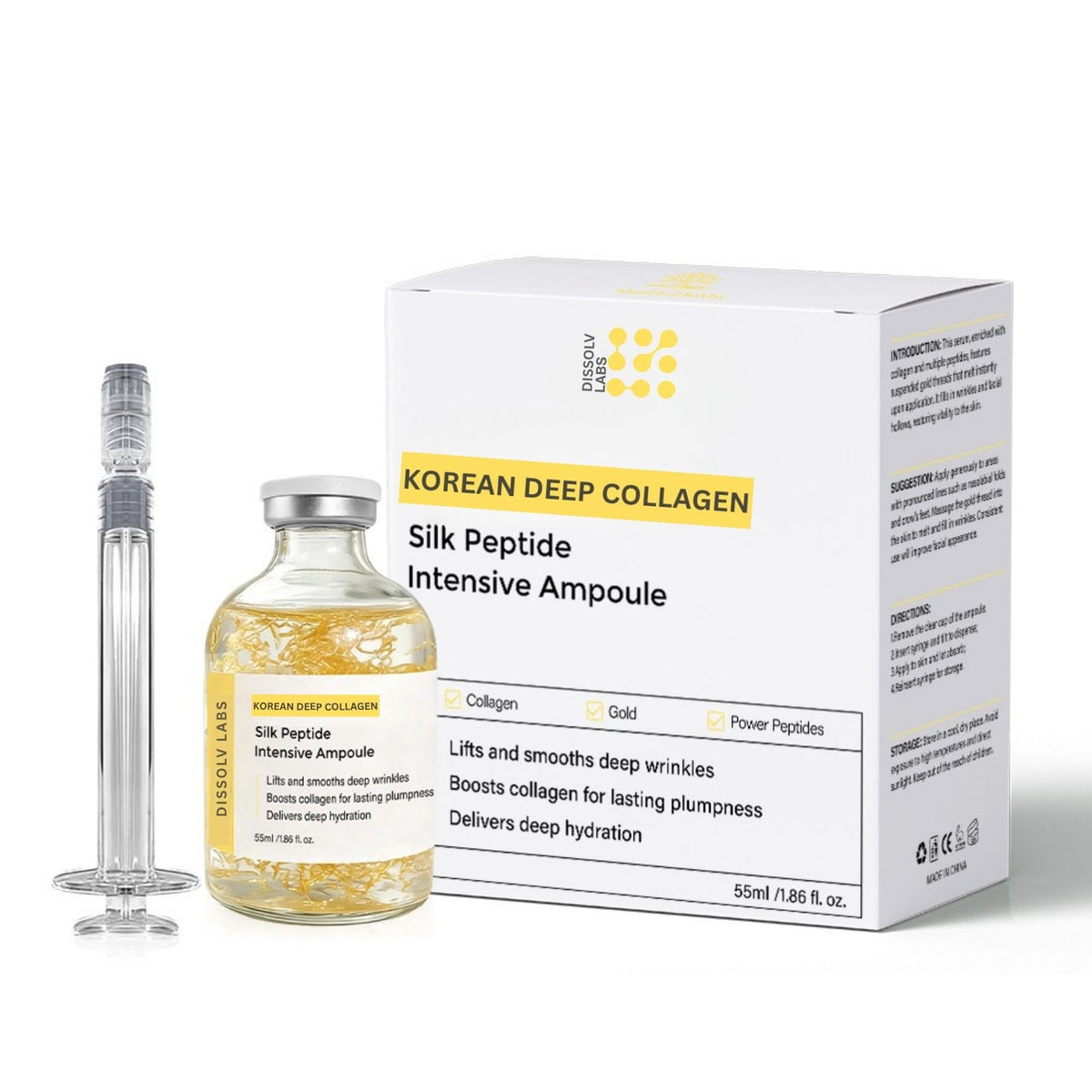
The Dissolv collagen and silk peptide ampoule is listed as a 55ml facial cosmetic supplied with a needle-free dispensing applicator. The visible bottle contains gold-toned threads. Those details describe its format; they do not quantify peptide concentration or demonstrate a clinical outcome.
The applicator is for dispensing the cosmetic onto the skin. It is not an injection device, and the product must not be injected. Follow the current carton and bottle directions. If the website and your package appear to disagree about ingredients, use or storage, contact the seller before using it.
A closer look at the 55ml ampoule
- Format: a 55ml topical facial cosmetic in a glass ampoule, with a reusable needle-free dispensing applicator.
- What to compare: the listing identifies collagen, a multi-peptide complex, adenosine, hyaluronic acid, squalane and panthenol as featured ingredients. Check the complete current ingredient declaration for your own preferences.
- Practical fit: worth reviewing if you prefer an ampoule format with controlled dispensing for an existing skincare routine.
Open the product page to see the bottle options and current price. If a particular ingredient or concentration matters to you, confirm it before ordering.
Fit the product into a simple routine
You do not have to buy an ampoule and a serum simply because both categories exist. Write down the role you want the additional product to fill, then check whether you already use something for that purpose.
The American Academy of Dermatology notes that using too many products can irritate skin. Its routine-order guidance places cleansing first, followed by prescribed medication or treatment, then moisturizer and/or sunscreen. Follow product-specific and clinician directions where relevant rather than assuming every formula belongs in the same sequence.
Check tolerability and handling
A new cosmetic can irritate skin even when its format feels familiar. The AAD recommends testing a product on a small area before adding it broadly to a routine. This consumer check is different from diagnostic patch testing performed by a clinician. Stop using a product that causes a reaction and seek professional advice if symptoms are severe or persistent.
Keep the container and applicator clean and follow storage instructions. FDA guidance explains that heat, air, moisture and repeated handling can affect cosmetic shelf life. An elaborate applicator does not make a product immune to contamination. Read FDA's shelf-life guidance for the underlying considerations.
Your five-question comparison checklist
- Can I find the complete ingredient list and current directions?
- Is any concentration claim stated clearly and supported?
- Does the evidence concern this finished formula and its topical use?
- Do the packaging, net volume and application method suit my routine?
- Can the seller answer questions about storage, origin and the specific product?
Choose the product you can evaluate clearly. A longer name or more elaborate bottle should not do the deciding for you. You can compare our current formats in the Dissolv skincare collection.
Does the ampoule format fit your routine? Review the product details and choose your bottle option on the product page.
By Dissolv Labs. Sources checked October 15, 2026. Educational information about topical cosmetics; not a diagnosis or a recommendation to treat a skin condition.


